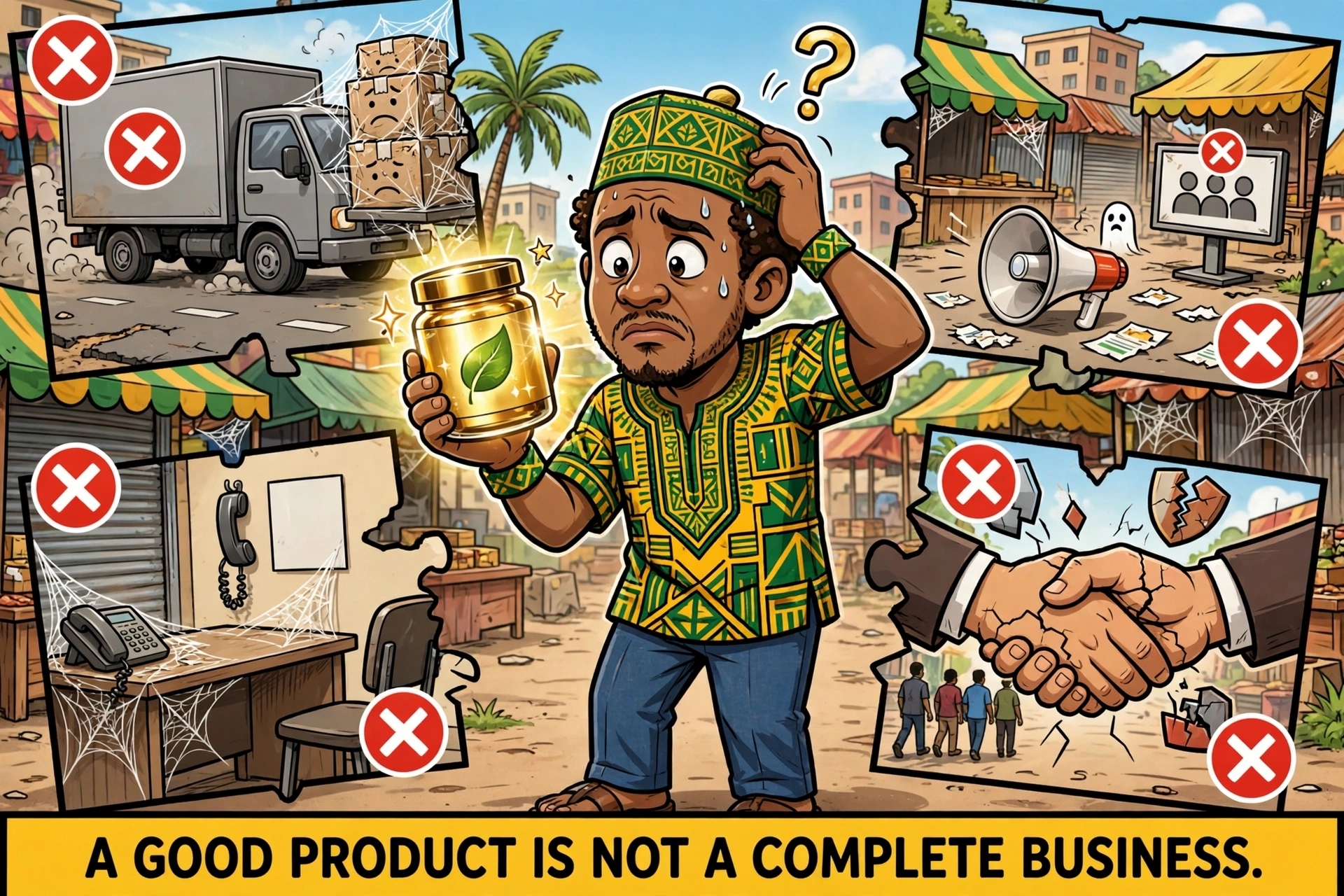
You can have the best product in your area and still struggle to make money from your business.
You can sell good palm oil, fresh bread, quality clothes, beautiful shoes or a product that people genuinely need, yet find yourself wondering why business is not moving as you expected. You know your product is good and people who have bought from you have praised it, some have even promised to tell their friends about it. But when you look at your accounts at the end of the month, the money is not there.
What happened?
The problem may not be your product, the problem may be that you have built a good product without building a complete business around it.
This is one of the mistakes many people make when starting a business. They spend so much time thinking about what they want to sell that they forget to think about how they will sell it, who will buy it, how much it will cost to keep selling it, and what will remain after all the expenses have been paid.
Let us take a simple example. Imagine two people who decide to start selling palm oil, both of them buy from the same supplier, and both sell good-quality palm oil. Their products are almost identical, and their customers are buying from the same market.
The first seller concentrates on the quality of the palm oil and makes sure it is clean, properly measured and free from adulteration. She believes that once people discover the quality of her product, the business will grow.
The second seller also cares about quality, but she asks a few more questions that the first seller is not asking. Who buys palm oil regularly? Where do these people usually buy it? How much can they afford to buy at a time? What makes them choose one seller over another? How much does it cost to transport the oil from the supplier? How much will she spend on containers, storage and delivery? How many litres must she sell each week to cover her expenses and make a reasonable profit?
She also considers whether she should sell directly to households, supply food vendors, sell to retailers or combine two or more of these methods.
Both sellers have good products, but they are not building the same kind of business.
The first seller has concentrated on the product, but the second is thinking about the entire operation.
Folks, that difference matters!
A Product Is What You Sell, But A Business Is How You Make It Work.
A product can be excellent without being commercially successful. People may admire it without buying it, buy it without coming back for more, or purchase it regularly while leaving the seller with very little profit.
A business must do more than offer something good, it must find people who are willing to pay for that product, make the product available to them, charge a price that makes commercial sense and deliver the promised value without spending more than the business can sustain.
Consider a person who makes beautiful shoes. The shoes are comfortable, durable and well finished, and everyone who sees them compliments the workmanship, but the business is still struggling.
After a closer look, the problem becomes clear: the shoes cost more to produce than the customers are willing to pay. The business has no reliable way of reaching new buyers, and the owner depends almost entirely on people who happen to see pictures of the shoes on social media.
In handling this situation, the owner responds by improving the designs and buying better materials.
Unfortunately, the business continues to struggle.
Why? Because the owner is trying to solve a business problem by improving the product.
Perhaps the shoes are already good enough for the intended customers. Perhaps the real problem is that the owner is selling to the wrong market, charging a price that does not reflect what customers can afford, or relying on a method of selling that does not consistently produce orders.
Improving a product is useful when the product needs improvement, it is not a substitute for understanding the business.
This is why a person can make a better product and still run a failing business.
Who Exactly Is Going to Buy It?
One of the first questions you should answer before investing heavily in a product is this: who will buy it, and why will they buy it from you?
It is not enough to say that everybody needs your product.
People need food, clothes, shoes, transport and shelter, but that does not mean every person is a potential customer for every business selling those things. Even when people need the same product, they may buy it for different reasons, in different quantities and at different prices.
A woman who buys palm oil for her household may purchase one litre at a time, a restaurant owner may need several litres every week, and a retailer may be interested in buying in larger quantities if the price allows room for resale profit.
These are different customers, and the way you sell to them may need to be different.
The household buyer may appreciate convenient delivery and small quantities, and the restaurant owner may care more about consistent supply, reliable measurements and a price that allows the restaurant to control its food costs. While the retailer may want a dependable supplier who can provide stock without unnecessary delays.
The product is the same, but the customers have different priorities.
If you do not know who your customers are, you may spend money trying to reach people who are unlikely to buy from you. You may also miss the people who would have become regular buyers if you had approached them properly.
Before starting a business, speak to potential customers. Ask what they currently buy, where they buy it, how often they buy it and what difficulties they experience with existing sellers. Find out what would make them consider buying from you.
Do not ask questions merely to hear people praise your idea. Ask questions that help you make better business decisions.
There is a difference between someone saying, “This is a good idea,” and someone actually paying for the product.
Compliments may encourage you, but purchases provide stronger evidence of demand.
A Good Product Still Needs a Way to Reach Customers
Imagine that you have found a product people want, and you can supply it at a reasonable price. You now have another problem to solve: how will the people who need the product find you?
Some business owners open a shop and wait for customers to arrive. Others create social media pages and post pictures of their products. Some depend on friends and family members to spread the word.
These methods can work, but none should be adopted without considering the customers you want to reach.
If you sell office supplies, for example, you may find that visiting offices and speaking directly with purchasing officers produces better results than waiting for individual customers to discover your social media page.
If you sell snacks, you may discover that supplying shops, schools where permitted, event organisers and offices creates more regular orders than selling only to people who contact you online.
If you sell clothes, your customers may come from social media, referrals, a physical shop or a combination of these channels.
The important question is not whether a particular sales method is popular, it is whether that method can reach the people who are most likely to buy your product at a cost your business can afford.
A business needs a deliberate method of finding customers and turning their interest into purchases.
It also needs a way to encourage satisfied customers to return. Depending entirely on finding new buyers every day can make business unnecessarily difficult, especially when the product is something people buy regularly.
If customers are satisfied with your product, make it easy for them to buy from you again. Keep your contact details accessible, communicate clearly, maintain consistent quality and make the buying process convenient.
A good product gives people a reason to consider buying from you. However, a good selling process gives them a reason to complete the purchase and return when they need the product again.
Let Us Talk About the Price
Many people determine their selling price by looking at what other sellers charge.
If the seller next door sells a product for ₦5,000, they sell theirs for ₦5,000. If another seller reduces the price to ₦4,500, they may reduce theirs too, hoping to attract more customers.
But have you considered whether the other seller has the same costs as you?
Perhaps that seller buys in larger quantities and receives a better price from the supplier. Or the seller has a cheaper source of transportation, lower rent or a different arrangement with suppliers. It is also possible that the seller is making very little profit or losing money without realising it.
You cannot build a sound pricing decision around another person’s price alone.
Suppose you buy a product for ₦3,000 and sell it for ₦4,000. At first glance, you appear to have made ₦1,000.
However, you spent ₦200 transporting the product, ₦100 on packaging and ₦150 on delivery expenses attributable to that sale.
Your remaining amount is ₦550, before accounting for other relevant business expenses that have not already been included.
If you also incur rent, staff costs, equipment expenses or other operating costs, those expenses must be considered when determining whether the business is making a profit.
The difference between your buying price and selling price is not automatically your final profit.
This is where many business owners get into trouble, they see money entering the business and assume that they are making money. So they continue selling, restocking and spending, only to discover later that very little has been left.
A business must know its costs, understand what customers are willing to pay and set prices that can support continued operation.
That does not mean you should always charge the highest possible price. Your price must make sense to your customers and remain competitive in your market, but a price that attracts customers while making it impossible to cover your costs is not a sound long-term solution.
The purpose of selling is not simply to make a sale, it is to make sales on terms that allow the business to survive and grow.
Sales Are Important, but Profit Matters Too
A business owner announces that sales have doubled within three months. Everyone congratulates the owner, and the business appears to be doing well.
But there is a question worth asking: has the profit also increased?
Imagine that a business generates ₦500,000 in sales in one month. After paying for the goods sold and the expenses incurred, the owner is left with ₦70,000.
The following month, sales increase to ₦800,000. However, the owner has spent more on advertising, delivery, discounts and additional stock. After the expenses are accounted for, only ₦40,000 remains.
The business has sold more but retained less.
This is why sales figures should not be the only measure of business performance.
You should know how much you sell, how much it costs to provide what you sell, how much you spend to operate the business and how much remains after the relevant expenses have been paid.
You should also understand when the money will actually enter your account.
A customer who buys goods worth ₦100,000 on credit may increase your recorded sales, but the money may not be available when you need to restock. If several customers delay payment while your suppliers require immediate payment, a business that appears profitable on paper can still struggle to meet its obligations.
Profit and cash flow are related, but they are not the same thing.
A business needs to make money from its operations, and it needs sufficient cash to pay its bills when they fall due.
This is particularly important for small businesses that operate with limited capital. One large unpaid invoice or an unexpected expense can disrupt the entire operation.
As a business owner, you must learn to keep proper records. Record sales, purchases, expenses, debts owed to you and debts you owe others, and also review those records regularly rather than waiting until you suspect something is wrong.
You cannot make sound decisions about money you do not properly account for.
Can You Keep Supplying the Product?
Let us return to our palm oil seller.
She has found customers who like her product, her prices are reasonable, and people are beginning to buy from her regularly.
Things appear to be working…
Then her supplier runs out of stock… Oops… She searches for another supplier but discovers that the available oil costs more. Transportation is also more expensive, and the new supplier cannot guarantee when the next delivery will arrive.
She now faces a difficult decision: should she increase her selling price, accept a smaller profit or risk losing customers by failing to supply them?
These are not merely product questions, they are business questions.
A business depends on more than what it sells today, it must also consider whether it can continue obtaining the product, maintaining its quality and delivering it to customers at a sustainable cost.
You do not necessarily need several suppliers from the beginning, and not every business can maintain large quantities of stock. However, you should understand the risks associated with depending on a single supplier, especially when your customers expect regular availability.
Think about the time it takes to replenish your stock, the money tied up in inventory, the possibility of price changes and the consequences of running out of goods.
Buying too little can lead to missed sales, but buying too much can tie up money in products that move slowly, expire, deteriorate or become difficult to sell.
The right amount of stock depends on the nature of the product, the speed at which it sells, the reliability of your suppliers and the cash available to the business.
A good product is valuable, but the ability to supply it consistently is part of what makes the business dependable.
Do Not Confuse a Busy Business With a Successful Business
Some business owners work from morning until night and still struggle financially.
They buy goods, attend to customers, answer messages, arrange deliveries, visit suppliers and spend their evenings calculating what they need to do the following day.
They are busy, but the business is not necessarily becoming stronger.
The problem may be that too much of their time is being spent on activities that do not produce enough value. It may also be that they have not developed a reliable way to handle routine operations.
For example, a seller who delivers every small order personally may discover that transportation consumes much of the money earned from those sales. Another seller may spend hours answering the same questions from customers because prices, product sizes and delivery terms are not clearly stated.
These problems can sometimes be reduced by setting minimum order quantities, arranging delivery schedules, grouping orders by location or providing clear product information before customers place orders.
The right solution depends on the business, but the principle is straightforward: examine how the business operates and identify where time and money are being wasted.
Do not assume that every activity you perform is necessary simply because you have always done it that way.
A business should not depend entirely on the owner remembering every order, calculating every expense mentally and personally handling every routine task. Even a small operation can benefit from written procedures, proper records and a clear division of responsibilities where other people are involved.
You may begin by doing almost everything yourself, and that is understandable when capital is limited, but as the business grows, you need to know which activities require your personal attention and which can be handled more efficiently.
Working hard matters, but hard work must be directed towards the things that make the business work.
Before You Invest More Money, Test Your Assumptions
One of the costliest mistakes an entrepreneur can make is investing heavily in an idea before finding out whether the business can work in practice.
A person may spend money renting a shop, buying equipment, purchasing large quantities of stock and printing branded packaging, only to discover that customers are unwilling to pay the expected price.
The intention was good, but the business decisions were made before enough had been learned about the market.
You do not have to eliminate every uncertainty before starting a business, that is rarely possible. However, you can reduce unnecessary risks by testing important assumptions before committing more money than you can afford to lose.
Suppose you want to start supplying snacks to offices, before renting a shop or buying expensive equipment, you could speak with office workers and administrators, find out which products they buy, establish the prices they consider reasonable and determine whether they would prefer individual purchases or regular supply arrangements.
Subject to any applicable requirements, you could then test demand with a small quantity of products, calculate the actual cost of fulfilling the orders and ask customers whether they would buy again.
The test should answer practical questions: Did people actually pay? Which products sold fastest? What did each sale cost you? Were customers satisfied? Did they reorder? Could you fulfil the orders without spending more than you had planned?
If the results are encouraging, you have evidence to support your next decision. If the results are disappointing, you can adjust your offer before committing more capital.
Perhaps the customers want smaller quantities, or maybe they prefer a different delivery arrangement. Perhaps the price is too high, or the product is not as important to them as you assumed.
Finding out early gives you an opportunity to correct the problem while the cost of doing so is still manageable.
A business idea is a starting point, but the real work is discovering whether you can turn it into a business that customers want and that you can operate profitably.
The Business Must Make Sense as a Whole
A successful business is not built by getting one thing right and ignoring everything else.
A good product matters because customers need a reason to buy; the right customers matter because a business cannot survive on general approval alone; pricing matters because sales must generate enough money to support the operation; distribution matters because customers must be able to obtain what they want; records matter because you need to understand what is happening to your money. These parts affect one another.
If your product is excellent but nobody knows it exists, sales may remain low. Similarly if customers want the product but your price does not cover your costs, the business may lose money. Also, if demand increases but you cannot obtain enough stock, you may disappoint customers. And if sales increase but customers do not pay on time, you may struggle to meet your own obligations.
This is why as a business owner, you must look beyond the product itself and ask yourself whether you know who your customers are, why they buy, how you will reach them, what it costs to serve them, how you will make a profit and what you will do when something goes wrong.
You do not need a complicated business plan to begin answering these questions, you need honest answers, accurate figures and a willingness to change your approach when the evidence shows that something is not working.
Start with the business you can afford to operate and also learn from actual customers, keep proper records, watch your costs, and ensure to pay attention to what sells, what does not sell and what remains after the expenses have been paid. Then improve the business based on what you learn.
A good product can attract attention, but attention alone will not pay your bills. Also, a good product can earn praise, but praise alone will not guarantee repeat purchases. And a good product can generate sales, but sales alone will not tell you whether you are making a profit.
Do not make the popular mistake of spending all your time building a product and forget to build the business that must sell it.