A woman opens a small business selling bags. She has spent money buying good products, taken beautiful pictures and posted them on Facebook. She has told her friends about the business, and a few people have even commented that the bags are beautiful.
But the orders are not coming…
She begins to wonder whether people no longer appreciate good products. Perhaps customers are broke, or maybe the market is too competitive, or maybe she even needs to spend money on advertising.
Before she spends another dime, however, there is something she needs to understand, and it is that people can admire your product without wanting to buy it.
The fact that somebody likes what you sell does not necessarily mean that the person needs it, can afford it, trusts you enough to pay for it or considers it important enough to buy now.
This is where many business owners get it wrong. They see a product that people praise and assume that sales should follow, and when sales do not come, they try to make the product more beautiful, reduce the price or advertise more aggressively, without first finding out why people are not buying.
Sometimes, the problem is not the product, it is the way the business is trying to sell it.
Consider the woman selling bags earlier in this post, perhaps the people seeing her posts are students who like the bags but cannot afford them, it could also be that her pictures show the bags without giving their prices, sizes or other information buyers need. Or customers are interested but do not know whether they can trust a seller they have never bought from. Sometimes it could even be that the bags are being shown to people who have little reason to purchase them.
Each of these problems requires a different solution. And to be honest, reducing the price will not automatically solve all of them, and spending more money on advertising may simply introduce the same problem to a larger audience.
So before trying to sell more, find out what is preventing people from buying.
Your Customers May Not Want What You Think They Want
Imagine that you sell food, and you believe your customers are interested in getting good food at an affordable price, so you concentrate on preparing delicious meals and keeping your prices low.
Yet another food vendor, whose meals are not necessarily better than yours, appears to attract more customers.
Seeing this, you become frustrated because you believe you are offering better value.
But have you considered that the other vendor may be closer to the customers’ workplaces, serve them faster or offer meals at the exact time they need them? Perhaps customers can place orders easily, or they know what will be available before they arrive.
You are concentrating on the food, while the customers are considering the entire buying experience.
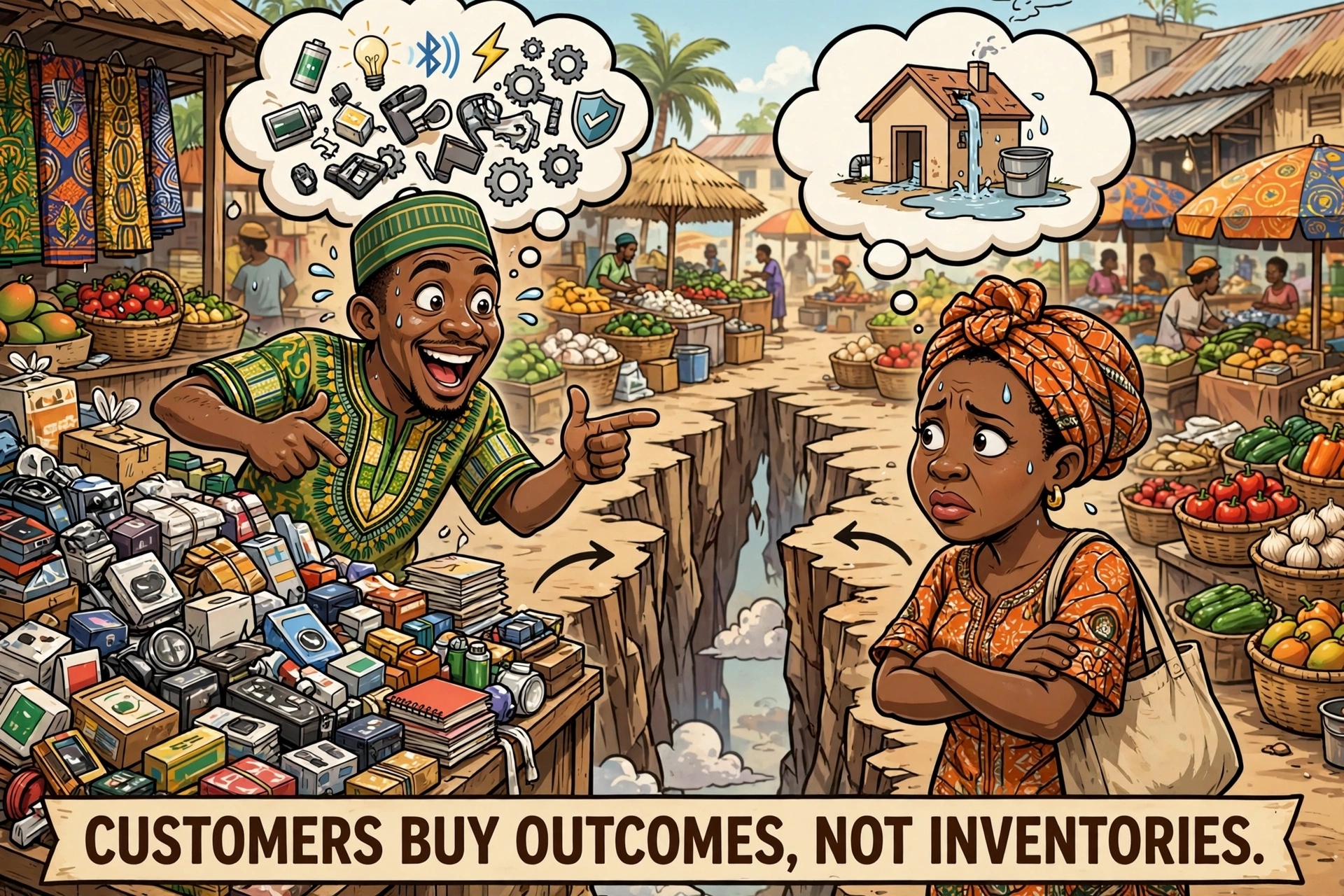
See, people do not buy products in isolation, they buy products to meet needs, solve problems, satisfy preferences or achieve something they consider worthwhile. The quality of the product matters, but so do convenience, timing, trust, price and the circumstances in which the purchase is made.
If you want to understand why customers are not buying, stop assuming you already know what matters to them.
Speak to people who have purchased from you, those who showed interest but did not buy, and even those who buy similar products elsewhere. Ask useful questions, listen carefully to the answers and look for patterns.
You may discover that the problem you have been trying to solve is not the problem your customers are experiencing.
Sometimes, You Are Making It Difficult to Buy From You
A customer sees your product online and becomes interested. The person sends you a message to ask for the price, but you reply several hours later. That customer lets the delay go and still proceeds to ask about delivery, and this time, you decide to take another hour to respond. By the time you finally wake up from your hibernation and provide the information, the customer has already purchased from somebody else.
And how did you later assess the situation? You simply concluded that the customer was not serious.
But sweetheart, that customer may have been ready to buy… You simply made the process unnecessarily difficult for them.
That is why it is important to consider how you sell your products. Can people find your prices or easily ask for them? Do they know what they are getting? Are your payment and delivery arrangements clear? Do you respond within a reasonable time? Are customers required to ask several questions before they can understand what you are offering?
Not every delay will cost you a sale, and to be fair, no matter what you do some customers will still abandon a purchase for reasons beyond your control. Nevertheless, unnecessary difficulty can discourage people who were genuinely interested in the first place.
A business owner may spend hours trying to attract customers while neglecting the simple things that help interested people complete a purchase.
Getting attention is one thing, but converting that attention into a sale is another.
Your Price May Not Be the Real Problem
When customers do not buy, many sellers immediately assume that their prices are too high. They begin offering discounts, reducing their profit and hoping that lower prices will bring more orders.
Sometimes, this works. In other cases, the price was never the main problem.
Suppose you sell a bag for ₦25,000, a potential customer sees the price and moves on. You assume the bag is too expensive, but you do not know whether the customer was looking for a bag at all, whether the customer trusted your business, whether the bag suited the person’s needs or whether the person had already purchased one elsewhere.
You have interpreted a customer’s silence as a price objection without establishing that price was the reason.
Before reducing your price, investigate what is happening. If customers consistently tell you that your product costs more than comparable alternatives, examine whether your price is justified by its quality, service or other advantages. If they are concerned about delivery, work on delivery. When they do not understand what makes your offer useful, explain its value clearly.
Do not keep reducing your price to solve a problem you have not first identified.
A lower price cannot create demand where none exists, and it cannot automatically make an unreliable business trustworthy.
Find Out Where You Are Losing the Sale
The next time a customer shows interest but does not buy, pay attention to what happens.
Does the person stop responding after seeing the price? Do people ask about a product repeatedly but rarely place orders? Do customers buy once and never return? Does your business attract many enquiries from people who cannot afford what you sell? These are different situations, and they tell you different things.
If people enquire but do not buy, examine your prices, product information, payment arrangements and the way you respond to enquiries.
If people buy once but never return, investigate product quality, customer service, expectations and whether the product is something they need repeatedly.
If your audience is full of people who admire your products but cannot afford them, you may need to reconsider whom you are targeting.
You do not need expensive research to begin learning these things, start with the conversations you are already having with customers.
Ask a person who decided not to buy whether there was something that influenced the decision. Do not argue with the answer or immediately try to persuade the person to change their mind because as a business owner, your purpose is to learn, not to win an argument.
Keep a simple record of the responses, and after some time, you may begin to see a pattern that was not obvious when you considered each customer separately. Then make one sensible change and observe what happens.
That is better than changing your price, product, advertising and selling method at the same time, only to discover that you still do not know what made the difference.
Your customers are giving you information about your business, even when they do not buy. Learn to pay attention to it!
A business does not grow merely because its owner believes in the product, it grows when the owner understands what customers need, gives them a convincing reason to buy and makes it reasonably easy for them to do so.
Before you spend more money trying to attract customers, find out why the ones you have already attracted are not buying.