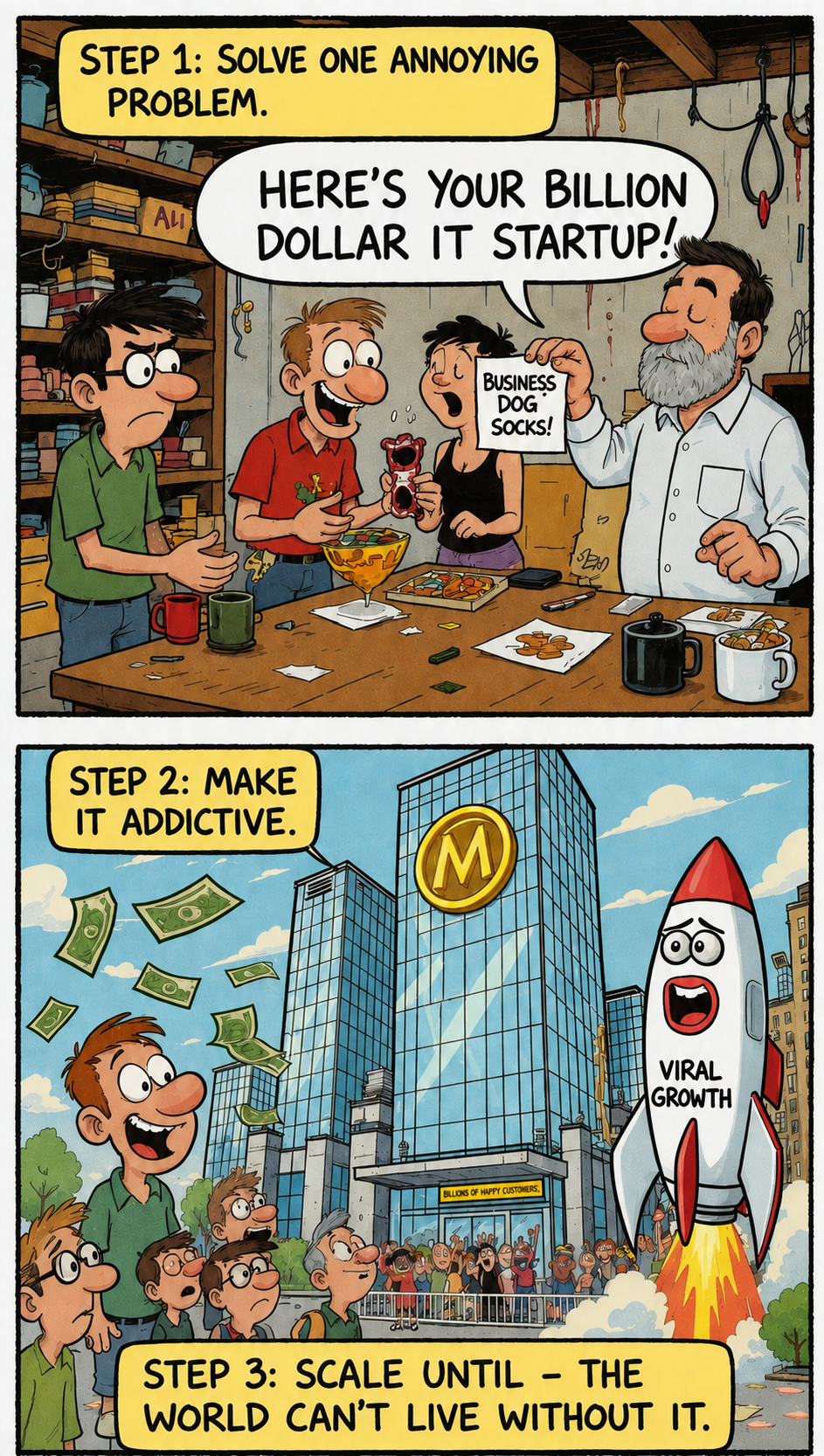
A business does not become worth a billion dollars simply because its owner had a brilliant idea.
In fact, some of the world’s most valuable companies started with ideas that were hardly revolutionary. What made the difference was what happened after the idea.
So what separates an ordinary business from a company that eventually becomes worth billions?
They solve a problem people actually have
The biggest companies usually make something easier, faster, cheaper, safer or more enjoyable.
Google made it easier to find information, Amazon made buying things more convenient, Uber made finding a ride easier in many places, and Microsoft built software that became essential to businesses and consumers.
The important thing is not necessarily inventing something nobody has ever seen before, sometimes it is simply finding a better way to solve an existing problem.
A business can have the most creative idea in the world, but if nobody wants it, it will struggle to survive.
They can serve a lot of people
A great local business can make its owner wealthy without ever becoming a billion-dollar company, and that is because its growth is limited.
A restaurant, hair salon or repair shop usually needs physical space, workers and equipment to serve more customers. There is a natural limit to how quickly it can expand.
Companies that reach enormous valuations often have something that can be reproduced at a much larger scale.
A piece of software can be sold to millions of people without manufacturing another physical copy for every customer, an online marketplace can connect millions of buyers and sellers, and a popular consumer product can be manufactured in enormous quantities and distributed across many countries.
The truth is that scale changes everything for you.
They find a way to keep making money
Revenue is important, but investors also want to know whether a company has a business model that can keep working as the company grows.
Consider a subscription service for instance.
If one million people each pay $10 every month, that is $10 million in monthly revenue. If the company can increase its customer base without its costs increasing at the same rate, its potential becomes much more interesting. This is one reason technology companies can grow so quickly.
Of course, not every billion-dollar company has enormous profits, some spend years prioritising growth over profit. Investors may tolerate that when they believe the company can eventually become extremely profitable.
They get people to come back
Getting someone to buy from you once is useful, but getting them to return again and again is much more valuable.
Think about the products and services you use repeatedly: your bank, your favourite messaging app, your email provider, your streaming service, your supermarket, even the software you use at work.
The more deeply a product becomes part of someone’s routine, the harder it can be for competitors to take that customer away. This creates something businesses love: recurring revenue and customer loyalty.
They build an advantage that is difficult to copy
A good idea can be copied, but a strong business is harder to copy.
Perhaps the company has a famous brand, perhaps it has years of customer data, a huge distribution network, valuable patents, a powerful community or an enormous number of users.
Sometimes the advantage is simply that the company got there first and became so large that catching up is extremely difficult. This is particularly important in industries where size itself creates an advantage.
They know how to grow
Growth is not just about selling more. A company has to know where to expand, which customers to pursue, what products to introduce and which opportunities to ignore.
Some companies grow by entering new countries, others acquire competitors, while some introduce completely new products.
The difficult part is growing without destroying the business that made the company successful in the first place. Plenty of companies become successful and then make terrible decisions when they try to become even bigger.
Timing matters more than people realise
Sometimes a company succeeds because its idea arrives at exactly the right moment.
A product that would have failed ten years earlier may succeed when technology, culture or consumer behaviour changes.
Smartphones created enormous opportunities for companies building mobile applications. Faster internet changed entertainment, communication and shopping. Likewise, artificial intelligence is creating another wave of businesses that would have been difficult to build a decade ago.
The founders may be talented, but they are also operating within circumstances they cannot completely control, so being in the right market at the right time can be enormously valuable.
The founders eventually build a company, not just a product
A small business can depend heavily on its owner, however, a billion-dollar company cannot. Eventually, there have to be systems, managers, employees, technology, processes and a culture that allow thousands of people to work towards the same goal.
This is one of the least glamorous parts of becoming a huge company, but it may be one of the most important.
A brilliant founder can start a company, but building an organisation capable of operating at enormous scale is another matter entirely.
Investors also matter
A company can grow from its own earnings, but some businesses need enormous amounts of capital to expand. This is where investors become useful.
Investors provide money because they believe the company could eventually become much more valuable. That money can be used to hire people, develop technology, open facilities, enter new markets, acquire other companies or simply survive long enough to reach profitability.
This is why a company’s valuation is not necessarily the same thing as the amount of money it has made. Obviously, a company can be valued at billions while still spending heavily.
So, is there a formula?
Not really…
Well, if there were a guaranteed formula for building a billion-dollar company, everyone would follow it.
The businesses that reach extraordinary valuations tend to have several things working in their favour at the same time: a large market, a useful product, strong execution, an ability to scale, a sustainable business model, talented people, good timing and sometimes a considerable amount of luck. And that last part is easy to overlook. What do I mean? Okay, look at this.
Two entrepreneurs can make equally intelligent decisions, work equally hard and build equally good products. However, one may encounter a market that suddenly explodes while the other enters just before a recession. To be honest, business success is not completely predictable.
What we can say is that billion-dollar companies rarely become billion-dollar companies by accident. They find something people want, build a way to deliver it at scale, create reasons for customers to stay and then keep making good decisions as the company grows.
The original idea matters, but eventually, execution, scale and timing matter just as much.
This is why, in our programme “Build Any Brand From Scratch,” we guide you in business decision-making, showing you how to spot opportunities and, of course, identify the right method and time for implementation. These are, basically, the foundations of any successful business.